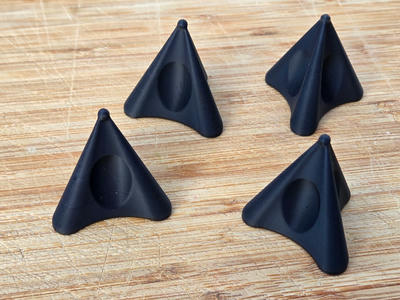
3D-Printed Painting Pyramids for Clean Work
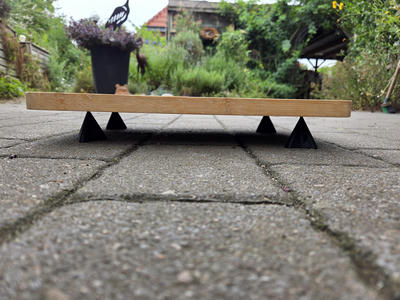
If you’re painting, spraying, or staining boards, moldings, or small pieces of furniture, you know the problem: By the time you get to the edges, you often don’t know how to lift or set the piece down without ruining the fresh finish.
These painting pyramids are designed exactly for that purpose. They lift your workpiece so you can comfortably work on all sides in one go. Thanks to the fine tip, the wood rests on just a tiny point—leaving barely visible marks after drying.
What makes these stands practical:
- Non-slip grip: Small recesses for rubber feet are built into the bottom. This prevents the pyramid from sliding on the workbench when you apply pressure with a brush or roller.
- Comfortable to handle: The recessed grips on the sides make it easy to securely grasp and position the painting pyramids, even with gloves on or slightly sticky fingers.
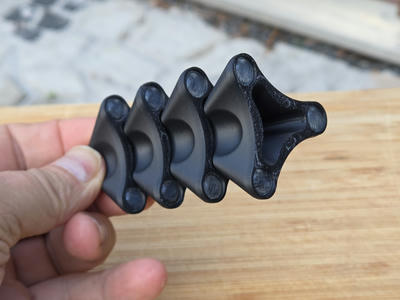
- Compact storage: After the project, you can simply nest them inside one another. The set takes up virtually no space in the workshop.
Printing & Use:
The STL files are available to you, so you can print as many copies as you like on your own 3D printer. Standard PLA or PETG are suitable materials.
For the bottom, you’ll need small, self-adhesive anti-slip pads (e.g., rubber or silicone pads) with a maximum diameter of 8.5 mm, which you can simply stick into the designated recesses.
Have fun printing these and enjoy your next painting project!
Overall Required Parts & Materials
- 1 xPaintingPyramids.stl
Material & Print Settings
The model is easy to print and doesn't have any special requirements for the filament. You can use practically any material.
I’ve successfully printed the pyramids with PLA and PETG—both work great and provide more than enough stability for everyday workshop use.
Recommended slicer settings:
- Wall loops:
2
(2 walls are more than enough to give the body sufficient strength and ensure the surface closes cleanly.) - Infill Pattern:
Lightning
(Saves a tremendous amount of filament and print time, since infill is only placed where it’s truly necessary for the upper layers.) - Infill Density: approx.
10–15%(with the Lightning pattern) - Support Structure: No, not required.
- Layer height:
0.2 mm(standard)
Thanks to the Lightning infill, the supports print in a flash, use very little material, and are still sturdy enough to hold heavy wooden boards.